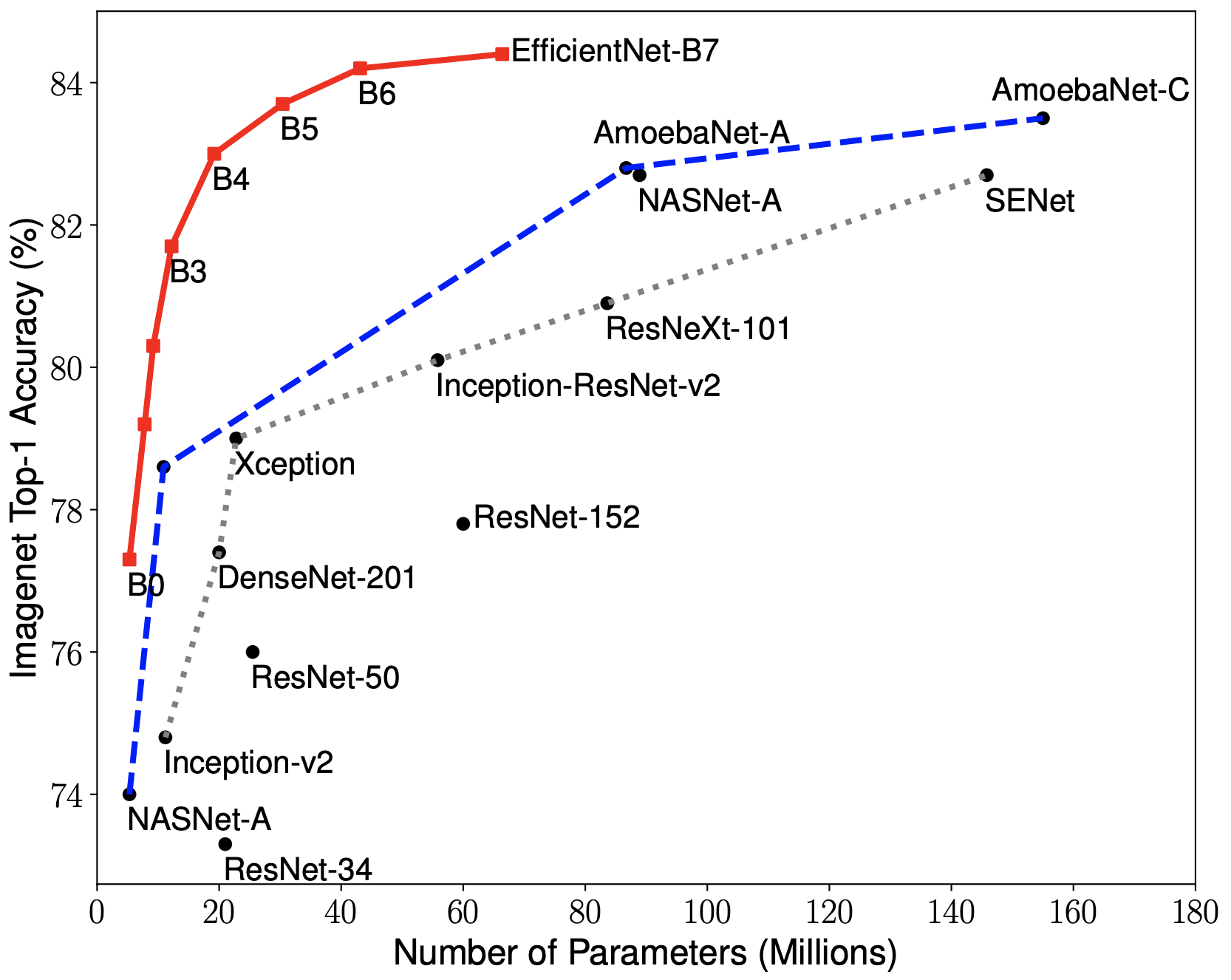
In plain words: Instead of enlarging a network's depth, width, or image size one at a time, this scales all three together with a single knob. The resulting family hits 84.3% accuracy on ImageNet while being 8.4x smaller and 6.1x faster than the best earlier network.
Abstract
Convolutional Neural Networks (ConvNets) are commonly developed at a fixed resource budget, and then scaled up for better accuracy if more resources are available. In this paper, we systematically study model scaling and identify that carefully balancing network depth, width, and resolution can lead to better performance. Based on this observation, we propose a new scaling method that uniformly scales all dimensions of depth/width/resolution using a simple yet highly effective compound coefficient. We demonstrate the effectiveness of this method on scaling up MobileNets and ResNet. To go even further, we use neural architecture search to design a new baseline network and scale it up to obtain a family of models, called EfficientNets, which achieve much better accuracy and efficiency than previous ConvNets. In particular, our EfficientNet-B7 achieves state-of-the-art 84.3% top-1 accuracy on ImageNet, while being 8.4x smaller and 6.1x faster on inference than the best existing ConvNet. Our EfficientNets also transfer well and achieve state-of-the-art accuracy on CIFAR-100 (91.7%), Flowers (98.8%), and 3 other transfer learning datasets, with an order of magnitude fewer parameters. Source code is at https://github.com/tensorflow/tpu/tree/master/models/official/efficientnet.
Mingxing Tan, Quoc V. Le
arXiv:1905.11946 · cs.LG, cs.CV, stat.ML · submitted May 28, 2019 · updated Sep 11, 2020
abstract · pdf · html · ICML 2019

As a quick summary, the problem the authors are trying to solve is this: suppose that you have a convolutional neural network that performs some task and uses X amount of computation. Now you have access to, say, 2X computation --- how should you change your model to best use the extra computation?
Generally people have taken advantage of the extra computation by widening the layers, using more layers (but of the same width), or increasing the resolution of the image. In this paper the authors show that if you do any of these individually, the performance of the NN saturates, but if you do all of them at the same time, you can achieve much higher accuracy.
Specifically what they do is conduct a small grid search in the vicinity of the original NN and vary the width, depth, and resolution to figure out the best combination. Then they just use those scalings to scale up to the required compute. This seems to work well across a variety of different tasks.
The main gripe I had with the paper was that they didn't do another grid search around the scaled up NN to verify that that the scaling actually held. In practice it seems to produce pretty efficient NNs, but maybe the scaling doesn't extrapolate perfectly and you can get an even better NN by applying some correction.