In plain words: Old step-by-step memory networks were stripped down by removing their extra memory controls, letting them train all at once instead of one step at a time. The simplified versions use fewer parameters yet match the popular attention-based models that replaced them across many tasks.
Abstract · Were RNNs All We Needed?
The introduction of Transformers in 2017 reshaped the landscape of deep learning. Originally proposed for sequence modelling, Transformers have since achieved widespread success across various domains. However, the scalability limitations of Transformers - particularly with respect to sequence length - have sparked renewed interest in novel recurrent models that are parallelizable during training, offer comparable performance, and scale more effectively. In this work, we revisit sequence modelling from a historical perspective, focusing on Recurrent Neural Networks (RNNs), which dominated the field for two decades before the rise of Transformers. Specifically, we examine LSTMs (1997) and GRUs (2014). We demonstrate that by simplifying these models, we can derive minimal versions (minLSTMs and minGRUs) that (1) use fewer parameters than their traditional counterparts, (2) are fully parallelizable during training, and (3) achieve surprisingly competitive performance on a range of tasks, rivalling recent models including Transformers.
Leo Feng, Frederick Tung, Mohamed Osama Ahmed, Yoshua Bengio, Hossein Hajimirsadeghi
arXiv:2410.01201 · cs.LG, cs.AI · submitted Oct 2, 2024 · updated Nov 28, 2024
abstract · pdf · html

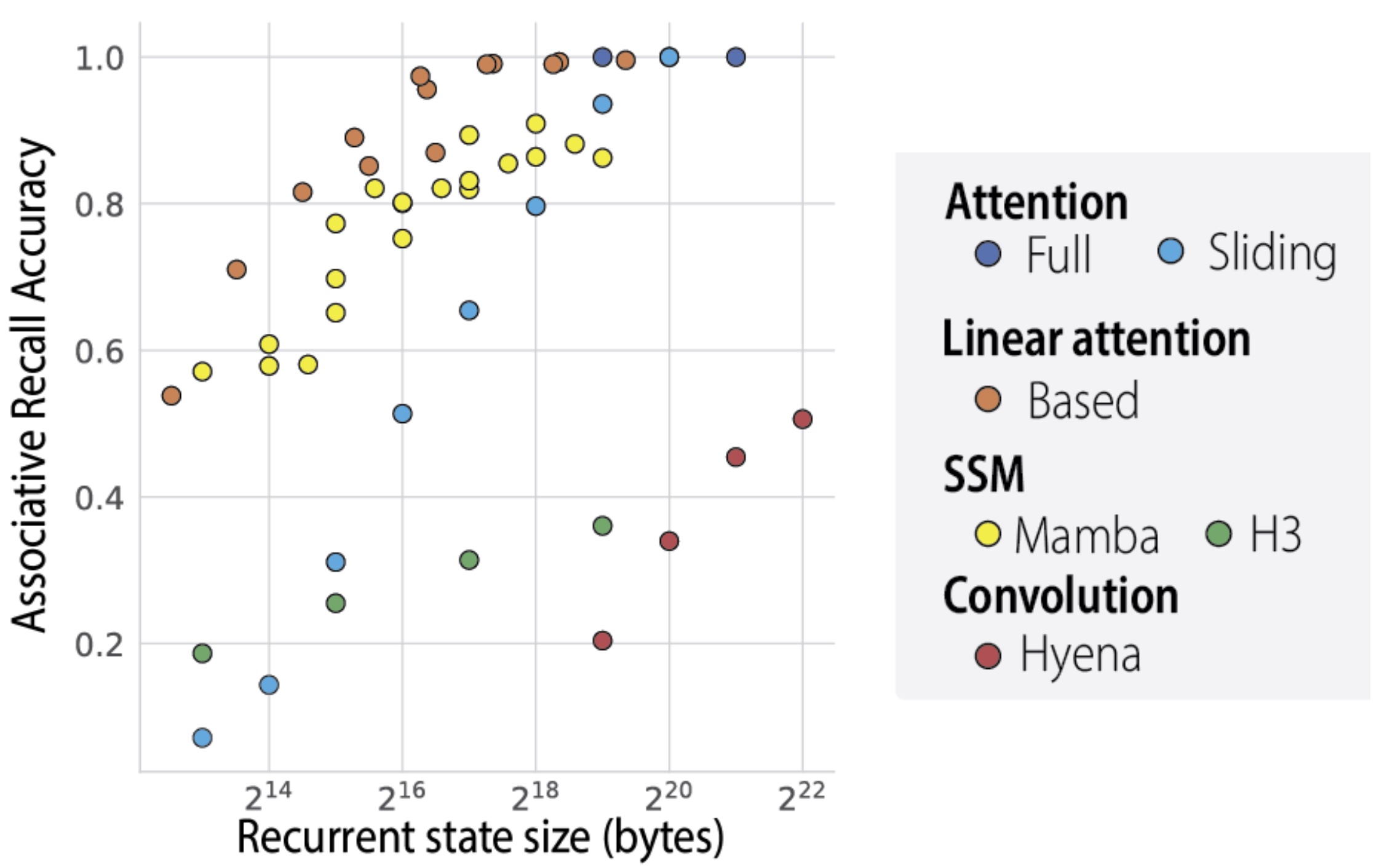
> RNNs are particularly suitable for sequence modelling settings such as those involving time series, natural language processing, and other sequential tasks where context from previous steps informs the current prediction.
I would like to draw an analogy to digital signal processing. If you think of the recurrent-style architectures as IIR filters and feedforward-only architectures as FIR filters, you will likely find many parallels.
The most obvious to me being that IIR filters typically require far fewer elements to produce the same response as an equivalent FIR filter. Granted, the FIR filter is often easier to implement/control/measure in practical terms (fixed-point arithmetic hardware == ML architectures that can run on GPUs).
I don't think we get to the exponential scary part of AI without some fundamentally recurrent architecture. I think things like LSTM are kind of an in-between hack in this DSP analogy - You could look at it as FIR with dynamic coefficients. Neuromorphic approaches seem like the best long term bet to me in terms of efficiency.